

Let's play with the magical number discovered by mathematics school teacher, Kaprekar: 6174
When we take any 4 random digits, of which at least 1 must be different from the other 3, arrange them from smallest to largest, and then subtract it from the same set of digits that have been arranged from largest to smallest, the result may well be 6174. If the result if not this number, then use that last result and arrange them into 2 numbers in the same way and subtract them from each other. Repeat these steps until the result is 6174. Once you get to this value, subsequent iterations just deliver the same result of 6174.
This quirky routine works for all numbers between 1 and 9998, excluding the repdigits 1111,2222,3333, etc.
Sometimes, it takes only 1 such iteration, sometimes more. Is it possible to determine in advance how many such iterations are required to reach the convergence to 6174?
Example
Choose 4 random numbers: 7346
Iteration 1: 7346Arranged largest to smallest: 7643Arranged smallest to largest: 3467Subtract the one from the other: 4176Iteration 2: 4176Arranged largest to smallest: 7641Arranged smallest to largest: 1467Subtract the one from the other: 6174
We have convergence! In this case, we only need 2 such iterations for this convergence.
It shouldn't come as a surprise that Kaprekar's Constant itself immediately converges to itself. Let's test this:
Iteration 1: 6174Arranged largest to smallest: 7641Arranged smallest to largest: 1467Subtract the one from the other: 6174
Yup, that is Kaprekar's Constant alright.
How many iterations to convergence?
What 4-digit value, bearing in mind that at least 1 digit must be different from the others, will cause the most iterations before converging to 6174? Can we determine in advance how many such iterations would be required to a given value?
Let's take a look, by trying this for all values up to 9999. Note than many values will have the same outcome, since they would contain the same digit combinations, e.g. 5432 would have the same result as 2345, 3452, 4523, 5423, etc.
Since there is a fair bit of processing to do for each value, it would make sense to put this in a function, rather than in-line it in a BASH one-liner. This function determines the number of iterations for a given input value and then outputs that input value and the found result to stdout. It is up to the code that called this function, what it does with this output.
function kapit {itcount=0└─ iteration counter ─┘result=$(printf "%04d" "$1") └─ our working intermediate result, starting with the 0 left-padded input parameter ─┘while : └─ this means loop forever ─┘dos1=$(echo "$result" | grep -o . | sort | tr -d "\n" | sed -e 's/^0\{1,3\}//' ) └─ put each digit on a new line ─┘ └─ arrange the lines in numerical order ─┘└─ join the lines up into a singel line ─┘└─ remove up to 3 leading 0s ─┘s2=$(echo "$result" | grep -o . | sort -r | tr -d "\n" | sed -e 's/^0\{1,3\}//' ) └─ put each digit on a new line ─┘ └─ arrange the lines in reverse numerical order ─┘└─ join the lines up into a singel line ─┘└─ remove up to 3 leading 0s ─┘result=$(bc <<< "$s2"-"$s1")└─ subtract the larger from the smaller ─┘[[ $result == 0 ]] && break └─ this was a 0,1111, 2222,..., so stop ─┘((itcount+=1))└─ increment the iteration count ─┘ [[ $result == 6174 ]] && break└─ we have converged, so stop ─┘result=$(printf "%04d" "$result")└─ left-pad with 0s to 4 digits for the next iteration ─┘doneecho "$1" "$itcount"└─ output to stdout ─┘}kapit-results.txt, which should give us a two-column data set:$ for i in {0..9999}; do kapit "$i"; done > kapit-results.txt$ head kapit-results.txt 0 0 1 5 2 4 3 6 4 4 5 6 6 6...
Plotting the data
A simple plot of the two-column data file, using GnuPlot, might give us some insight into the posed questions:
$ gnuplot...gnuplot> plot "kapit-results.txt"... and when you tired of viewing the plot, you can exit gnuplot with:gnuplot> exit
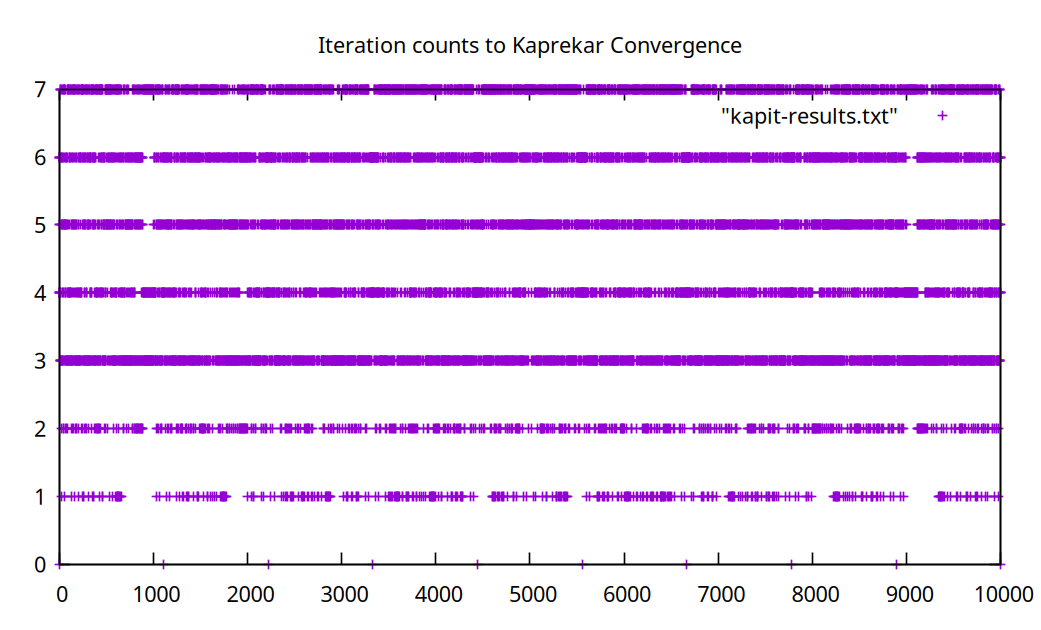
What can we infer from the graph?